Showing posts with label work in progress. Show all posts

Sunday, September 13, 2009

Characters Butting Heads

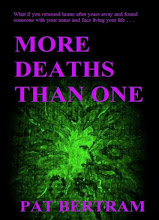
When I wrote the first draft of my novel More Deaths Than One (and the second draft and the third) I had the hero Bob meandering around his world trying to unravel his past all by himself, and it was boring. Did I say boring? It was moribund. The story went nowhere because there was no one for Bob to butt heads with.

As an aside: this is my current metaphor for a good story — characters butting heads with each other and spinning off in new directions. Too many authors today have their characters butting heads, moving straight back and butting heads again. If the characters don’t ricochet off into a different direction each time, you have characters that don’t change and hence you have a static story.

In the fourth draft of More Deaths Than One, I gave Bob a love interest, a waitress he met at a coffee shop. (Hey, so it’s been done before. The poor guy spent eighteen years in Southeast Asia, and didn’t know anybody stateside. How else was he supposed to meet someone?) That’s when the story took off. He had someone to butt heads with, someone to ooh and aah over his achievements, someone to be horrified at what had been done to him.

From that, I learned the importance of writing scenes with more than one character.

So why am I mentioning this?

Well, I’ve hit a hole in my work-in-progress, a possible weakness. The hero of this whimsically ironic apocalyptic novel, Chip, loses one person after the other until he is alone. (I’m not giving anything away here. I already told you the work was apocalyptic.) There will be plenty of conflict as he contends with his new environment, but it might get boring without other characters for him to interact with.

There will be no problem once he ends up in the human zoo in the second part – his problem there (though not mine as the writer) is that he will have too many people to contend with. The same holds true for the third part of the book when he escapes. So there will be only about sixty pages where he is alone.

I do have one thing in my favor. I am a much better writer than I was when I wrote the first draft of More Deaths Than One, so perhaps I can keep the story going with Chip alone. (Saying I am a much better writer now is not necessarily saying I am a good writer. The first draft of More Deaths Than One was laughably bad. That I found an agent for it says more about the agent than it does my writing. No surprise – he couldn’t sell it.)

Chip does have to be alone at the end of the first part; he has an important step to take and must be by himself to take it. He also has to go through some experiences alone because they are essentially in his mind (or at least he thinks they are), but who will he be butting heads with the rest of the time? I’ll have to think about this.

Monday, September 29, 2008

Characters Who Want: Passionate or Spoiled?

Nope. Sorry. Can’t do it.

Although I’ve been telling you that to get published in today’s market you need a character who wants something desperately, I’ve never been able to do it. I spend so much time with my characters during the creation and writing of my novels that I have to like them or at least tolerate them. Passionate characters, like Scarlett O’Hara, who go after their goals with no thought for anyone else, might be interesting to you, but to me they are spoiled brats and intolerable.

Perhaps if I could have overcome this prejudice and followed my own advice, I’d have found a publisher by now. Unfortunately for me, all of my heroes have been reactive rather than proactive, at least in the beginning. Seems like I’m going to be making the same mistake again, but I have to go with what feels right.

I just don’t see Chip, the hero of my work in progress, as a driven fellow. Except for his problem with his mother, he seems to be satisfied with his life. He does have a long-term goal: he would like to buy a ranch or farm and take care of old and unwanted animals from zoos and circuses, but since this goal is negated when the world ends, it can’t be a desire that drives him throughout the book.

Still, there has to be a unifying characteristic that is with him throughout all of his adventures. He is distrustful of women because of his mother (and perhaps because of past relationships). That distrust could be his motivating factor, until at the end he finds a woman he can trust. It would also suit his temperament.

In The Writer’s Guide to Character Traits, Linda N. Edelstein, PhD, lists styles of behavior and explains the psychology of each. Reviewing the list, I can see that Chip does not have an adventurer’s personality, nor is he bossy, conventional, creative, a conformist, dependant, eccentric, a fall guy, fearful, flamboyant, hyper, a loner, a man’s man, passive-aggressive, a show-off, a victim.

But he is resilient. According to Edelstein, this means he has the ability to recover from losses and disappointments. He is generally happy and productive. He can face his problems and cope with adversity. He is an effective problem solver. He has high ethical standards and takes responsibility for his own life. He has a sense of humor. He is interested in others as well as himself and maintains a strong support network. In the extreme, his independence can become an inability to depend on others, which goes along with his distrust of women.

Maybe he is not an exciting and passionate character, but he sounds like someone I could live with for the next year while I am writing the novel.

Of course, this isn’t all there is to him. He does have special strengths and weaknesses that cause the plot to thicken at times, but I don’t know yet what they are.

I’ll have to get back to you on that.

Sunday, September 14, 2008

Boldness Has Power and Magic in It

All too often inexperienced writers tiptoe through their novels, letting major events -- fistfights, gunplay, murders, betrayals -- take place off-page. It's much easier to let characters emote afterward than for the writer to take the time and trouble to tackle the action scene. I know I have passed on opportunities to create such scenes, thinking the characters' reactions all-important, but I forgot one thing: readers need to experience the drama.

Sometimes it's hard to find the confidence to bring such complex scenes to life, to juggle the many elements that comprise an action scene, but the only way to learn is to plunge headfirst into action. Write it fast and fearlessly; let the words fall where they may. You can always clean up the mess in rewrites, so there is no reason to hold back.

By jumping into situations that test your characters and your writing ability, you can give your stories drama that stands apart from the common. Writing is an adventure and we need to boldly go where our story takes us.

Goethe wrote, “What you can do, or dream you can, begin it; boldness has genius, power and magic in it.”

I’ve dreamed my new novel. Now it’s time for me to begin writing it. Perhaps this bold step will bring, if not genius and power, then magic.