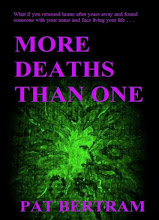
When I wrote the first draft of my novel More Deaths Than One (and the second draft and the third) I had the hero Bob meandering around his world trying to unravel his past all by himself, and it was boring. Did I say boring? It was moribund. The story went nowhere because there was no one for Bob to butt heads with.
As an aside: this is my current metaphor for a good story — characters butting heads with each other and spinning off in new directions. Too many authors today have their characters butting heads, moving straight back and butting heads again. If the characters don’t ricochet off into a different direction each time, you have characters that don’t change and hence you have a static story.
In the fourth draft of More Deaths Than One, I gave Bob a love interest, a waitress he met at a coffee shop. (Hey, so it’s been done before. The poor guy spent eighteen years in Southeast Asia, and didn’t know anybody stateside. How else was he supposed to meet someone?) That’s when the story took off. He had someone to butt heads with, someone to ooh and aah over his achievements, someone to be horrified at what had been done to him.
From that, I learned the importance of writing scenes with more than one character.
So why am I mentioning this?
Well, I’ve hit a hole in my work-in-progress, a possible weakness. The hero of this whimsically ironic apocalyptic novel, Chip, loses one person after the other until he is alone. (I’m not giving anything away here. I already told you the work was apocalyptic.) There will be plenty of conflict as he contends with his new environment, but it might get boring without other characters for him to interact with.
There will be no problem once he ends up in the human zoo in the second part – his problem there (though not mine as the writer) is that he will have too many people to contend with. The same holds true for the third part of the book when he escapes. So there will be only about sixty pages where he is alone.
I do have one thing in my favor. I am a much better writer than I was when I wrote the first draft of More Deaths Than One, so perhaps I can keep the story going with Chip alone. (Saying I am a much better writer now is not necessarily saying I am a good writer. The first draft of More Deaths Than One was laughably bad. That I found an agent for it says more about the agent than it does my writing. No surprise – he couldn’t sell it.)
Chip does have to be alone at the end of the first part; he has an important step to take and must be by himself to take it. He also has to go through some experiences alone because they are essentially in his mind (or at least he thinks they are), but who will he be butting heads with the rest of the time? I’ll have to think about this.


I’ve always enjoyed working with my hands to create original art pieces and
because I’ve tried quite a few different areas of art, I rather quickly
realize...

 Posts
Posts


